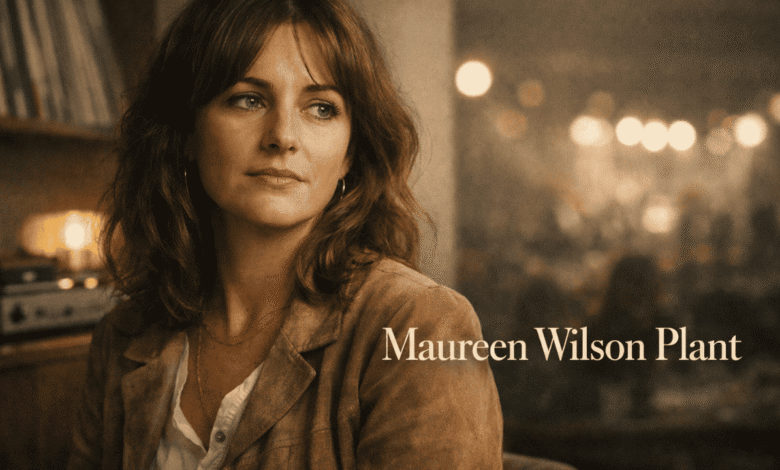
Maureen Wilson Plant never chased the spotlight, and that refusal is exactly why her story still holds weight. She lived at the edge of one of the loudest cultural movements of the twentieth century and chose restraint over spectacle. That decision shaped not only her own life, but also the emotional backbone of a body of music that millions still treat as sacred. Writing about Maureen Wilson Plant isn’t about celebrity proximity. It’s about influence without noise, presence without performance, and the cost of loving someone whose life exploded in public while yours stayed private.
Early Roots That Rarely Make the Headlines
Maureen Wilson Plant was born in 1948, with early childhood years linked to Kolkata before her family relocated to England. That move mattered more than most bios admit. Growing up between cultures shaped her sense of identity long before fame entered the picture. By the time she settled into life in the English Midlands, she wasn’t chasing novelty. She was building stability.
This background explains a lot about how Maureen Wilson Plant navigated later chaos. She didn’t romanticize the music scene or treat it as an escape. She understood transition, loss, and adjustment early on. Those skills became survival tools when the world around her turned unstable.
Her early years also explain why she never leaned into public storytelling later. People who grow up crossing borders often learn when silence is strength.
Meeting Robert Plant Before the Myth Existed
Maureen Wilson Plant met Robert Plant in the mid-1960s, before stadiums, before the mythology, before the excess hardened into expectation. At that point, he was another ambitious musician with talent and hunger, not a cultural force. Their connection formed in ordinary spaces: shows, conversations, shared youth.
This matters because Maureen Wilson Plant knew the person, not the persona. When fame arrived fast and violently, she wasn’t dazzled by it. She had already seen the raw version. That grounding presence became essential as Led Zeppelin rose at a speed few artists survive intact.
Their marriage in 1968 happened just as the band launched. There was no warm-up period. Domestic life and global fame collided immediately.
Marriage Inside a Cultural Earthquake

Being married to Robert Plant during Led Zeppelin’s rise wasn’t glamorous. It was exhausting, isolating, and unpredictable. Maureen Wilson Plant held the home together while her husband disappeared for months, returned altered, then left again. That pattern tests any relationship.
What often gets overlooked is how young she was while carrying that weight. She became Maureen Wilson Plant in name, but not in power. The public cared about the singer. She managed the fallout.
Friends and observers from that era often note that she grounded him emotionally during the band’s most volatile years. That influence didn’t come from strategy or control. It came from familiarity and honesty, things fame erodes quickly.
Motherhood and Loss That Changed Everything
Maureen Wilson Plant’s life narrowed around her children in ways the public never saw. Motherhood wasn’t a side note. It was central. The birth of their daughter Carmen brought joy into an otherwise unstable routine, but it was the death of their son Karac in 1977 that permanently altered the family’s direction.
Karac’s illness and death at age five shattered the marriage’s remaining illusions. For Maureen Wilson Plant, grief wasn’t symbolic. It was daily and relentless. For Robert Plant, it bled into his music. Songs written after that loss carry a different tone, stripped of bravado.
This moment marks the emotional breaking point. Nothing that came after can be understood without acknowledging it.
Life After the Marriage Ended
When Maureen Wilson Plant divorced Robert Plant in 1983, she stepped away without commentary. No interviews. No memoir. No quiet media tour. That silence wasn’t accidental. It was a boundary.
Post-divorce, Maureen Wilson Plant focused on rebuilding a life outside public definition. She raised her children, maintained privacy, and avoided the nostalgia industry that would have welcomed her with open arms. That restraint is rare and deliberate.
People often mistake absence for insignificance. In her case, absence was the point.
Why Her Privacy Still Matters
There’s a reason Maureen Wilson Plant remains difficult to pin down. She never converted proximity into currency. In a culture that rewards exposure, she refused the transaction.
That choice matters because it challenges the assumption that every story needs to be monetized. Maureen Wilson Plant demonstrates another path: influence without ownership, presence without proof, memory without narration.
Her privacy also protects her children, who grew up without being forced into legacy branding. That decision has long-term consequences that feel more important than any headline.
The Emotional Imprint on Music History
It’s impossible to separate Maureen Wilson Plant from the emotional arc of Robert Plant’s writing during the 1970s. Songs inspired by love, distance, grief, and regret weren’t theoretical. They came from lived experience.
What makes this significant is that Maureen Wilson Plant never tried to claim that influence publicly. She didn’t annotate lyrics or correct interpretations. She let the work stand alone.
That restraint gave the music space to resonate without turning her life into a footnote.
Why Interest in Maureen Wilson Plant Has Grown
Public curiosity about Maureen Wilson Plant has increased in recent years for one reason: people are tired of overexposed stories. Audiences now look for the quiet figures who shaped outcomes without demanding recognition.
Her story appeals to readers who value restraint, emotional labor, and influence that doesn’t announce itself. She represents a counter-narrative to celebrity culture, and that contrast feels sharper as time passes.
Maureen Wilson Plant didn’t disappear. She simply chose not to perform.
Correcting the Simplified Narrative
Too many profiles reduce Maureen Wilson Plant to a label: first wife, muse, footnote. That framing misses the point. She wasn’t orbiting fame. Fame crashed into her life.
Understanding Maureen Wilson Plant requires abandoning the usual celebrity lens. Her impact wasn’t public-facing. It was domestic, emotional, and deeply human. That kind of influence rarely photographs well, but it lasts.
The Real Takeaway
Maureen Wilson Plant matters because she proves that significance doesn’t require visibility. She lived through cultural upheaval, personal tragedy, and public erasure without trading her interior life for attention. That choice gave her story durability.
If there’s a lesson here, it isn’t about music or fame. It’s about knowing when to step back, protect what matters, and let history speak without your narration.
Maureen Wilson Plant never asked to be remembered. That’s why she is.
FAQs
What is the biggest misconception about Maureen Wilson Plant?
That her importance comes only from who she married, rather than from the emotional and practical role she played during a volatile era.
Why did Maureen Wilson Plant stay out of the public eye after her divorce?
Because privacy was a deliberate boundary, not a missed opportunity. She prioritized family and personal stability over public relevance.
How did the loss of her son affect her life trajectory?
It shifted everything. Grief redefined her priorities and accelerated her withdrawal from a life tied to constant movement and exposure.
Did Maureen Wilson Plant ever consider writing a memoir?
There’s no evidence she pursued that path, despite clear public interest. Silence appears to have been a conscious choice.
Why does her story resonate more today than in the past?
Because audiences now recognize the cost of fame and value stories shaped by restraint rather than self-promotion.